
What Is Shibari? A Beginner-Friendly Guide to Rope, Meaning and Practice

A common first question in rope is beautifully simple: “What is shibari?”
The answer is useful, but it can easily become too narrow. Some people picture elegant rope photographs. Others think immediately of BDSM or erotic play. Some hear the word kinbaku and wonder whether they have already misunderstood something. In practice, shibari can be technical, aesthetic, physical, emotional, social, intimate, playful or challenging, depending on the people and the context involved.

What does “shibari” mean?
Shibari is a Japanese word that literally means “to tie” or “to bind.” Outside Japan, it is commonly used to describe Japanese-inspired artistic rope bondage. That definition is a useful starting point, but it does not describe every experience people may have with rope.
The word can name the practice, but it cannot tell you what a particular session will feel like, what the people involved want from it, or how they have agreed to engage with one another.
Shibari, kinbaku and rope bondage
The terms around rope overlap, and different teachers, communities and countries may use them differently. Shibari is commonly used outside Japan for Japanese-inspired artistic rope bondage. Kinbaku is a related Japanese term; some people use it interchangeably with shibari, while others use it to emphasise the emotional, erotic or relational experience created through rope. Rope bondage is broader still and can describe using rope to restrain, decorate or support the body across a wider range of styles and traditions.
Terminology can help you navigate classes, events and conversations, but no label replaces asking what someone actually means and what they want to do.

Why do people practise shibari?
There is no single correct reason. People may come to rope for creativity, sensation, trust, learning, relaxation, performance, photography, community, technical problem-solving or personal challenge. Several of these can exist at the same time, and a person’s reasons may change as they gain experience.
For one person, rope may be primarily artistic: lines, shapes and patterns across the body. For another, it may be technical: structure, tension, handling and problem-solving. Someone else may be more interested in physical sensation, stillness, movement, communication or connection.
A tie does not need to be visually dramatic or technically advanced to be meaningful. Simple floor-based practice can be just as relevant to someone as suspension or performance.
Is shibari always sexual?
No. For some people, rope is intimate, romantic, erotic or connected to BDSM. For others, it is an art form, a physical practice, a creative hobby, a learning activity, a performance medium or a social interest.
The meaning of rope does not come from the rope alone. It comes from the people, the agreement and the setting. You do not need to want the most intense, erotic, athletic or performative version of rope in order to be interested in it.
Communication is central
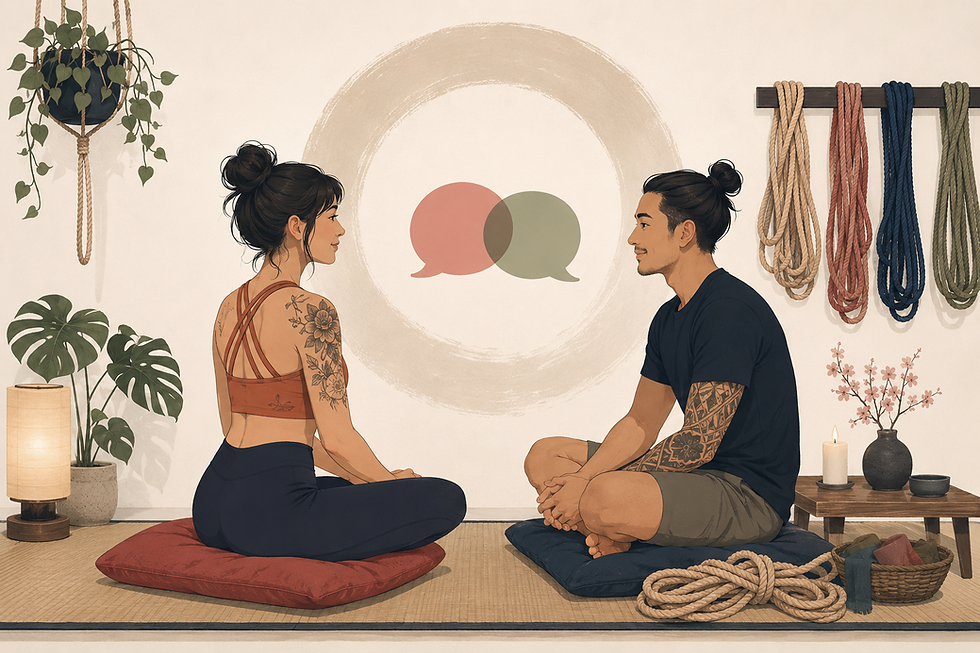
Because shibari can mean different things to different people, clear communication matters more than the label. Good rope practice depends on consent, negotiation, boundaries and checking how people are feeling before and during a session.
If someone says, “I’m interested in shibari,” useful follow-up questions might include: What kind of rope are we talking about? What are we hoping to experience? What is off-limits? How will we communicate? What pace feels appropriate?
This is why no label can replace negotiation. The clearer the conversation, the less work the word itself has to do.
Rope involves risk
Rope can look calm and beautiful while still involving physical and relational risk. Safer practice includes learning from experienced instructors, understanding foundational safety principles, negotiating expectations and boundaries, monitoring comfort and wellbeing, and progressing gradually.
Beginners commonly start with instruction, basic rope handling, simple foundational ties and floor-based practice before moving toward more advanced loading or suspension. Learning to notice discomfort and communicate early is part of learning rope, not a sign that something has gone wrong.

A definition should make rope more approachable, not smaller
Definitions can accidentally become gates. If shibari is described only as erotic, some people assume they are not allowed to be curious. If it is described only as art, the importance of consent and communication can disappear. If it is described only as technique, the emotional and relational experience can be missed.
A fuller definition is this: shibari is a Japanese-inspired practice of tying people with rope that may involve art, technique, sensation, communication, trust, intimacy, challenge, relaxation, creativity or social connection. It is shaped by the people practising it, and it requires consent, care and ongoing learning.
Start with curiosity
You do not need one perfect reason to be interested in shibari. You can be curious about movement, patterns, technique, connection, relaxation, sensation or simply trying something new. Your interests may change as you learn.
The useful question is not whether your interest “counts.” It is what kind of rope experience you want to explore, what boundaries matter, and how you can communicate clearly with the people involved.
At That Rope Place, we see rope as something people can approach at their own pace. Curiosity is enough of a starting point.


Comments