
Why Do People Enjoy Getting Tied Up?

Updated: Aug 9
If you've never tried rope before, it's easy to wonder:
"Why would anyone want to be tied up?"
The answer is surprisingly simple: there isn't one.
People come to rope for many different reasons, and those reasons often change over time. What begins as curiosity may grow into a creative hobby, a way to connect with others, or simply a chance to slow down after a busy week.
There is no single "right" motivation, and you don't need an elaborate explanation to be interested in rope. Your reason is valid, whatever it may be.
There Is No Single Right Reason
One of the wonderful things about rope is that it means different things to different people.
Some people enjoy:

Relaxation
Physical sensation
Trust and connection
Creativity
Personal challenge
Mindfulness
Learning new skills
Community
Simple curiosity
Many people experience several of these at once, and their reasons may evolve as they gain experience.
Relaxation and Grounding
Modern life can feel busy, noisy and constantly demanding.
For some people, rope offers an opportunity to slow everything down.
The process of focusing on breathing, communication and the feeling of the rope can help people become more present in the moment. Rather than thinking about work, emails or tomorrow's responsibilities, their attention returns to what is happening right now.
Many people describe this experience as calming or grounding.
Not everyone experiences rope this way, but for those who do, it can become an important form of relaxation.
Enjoying Physical Sensations
Rope creates a wide variety of physical sensations.
Different ties can produce feelings such as:
Gentle pressure
Compression
Stretching
Restriction of movement
Comfortable stillness

Some people simply enjoy these sensations in the same way others enjoy a deep tissue massage, weighted blankets, yoga or other physical activities.
Every person experiences these feelings differently, and no two people enjoy exactly the same things.
Trust, Communication and Human Connection
Rope is rarely just about the rope.
Instead, it is often about the interaction between people.
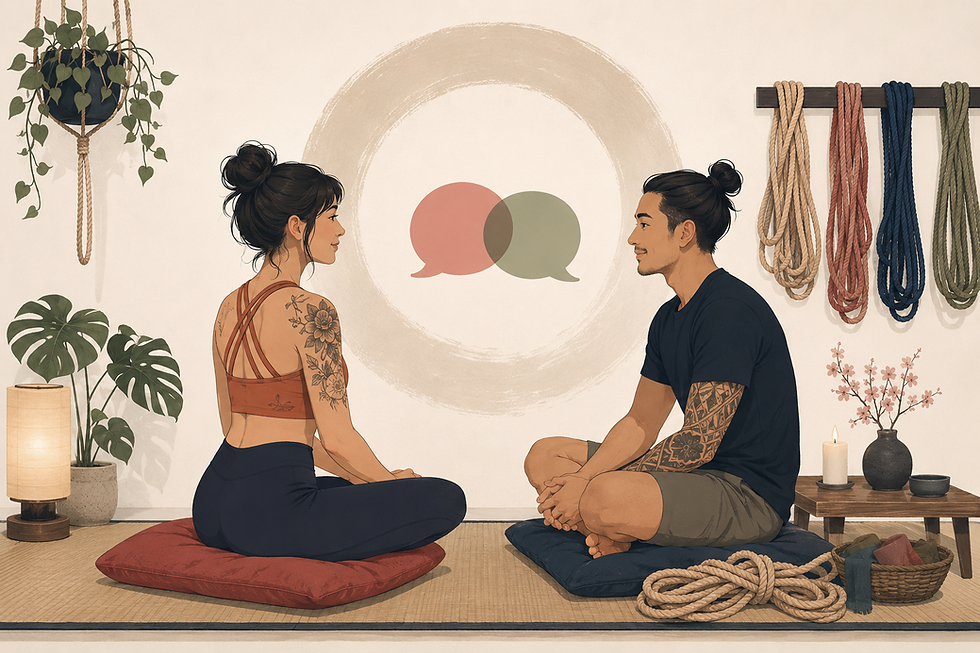
Creating a rope scene typically involves conversation, cooperation and continual communication. Partners check in with one another, adjust to each other's needs and work together to create a shared experience.
For many people, this sense of trust and mutual attention is one of the most rewarding parts of rope.
Strong communication doesn't just make rope safer—it can also make the experience feel more meaningful.
Creativity and Beauty
Many people are drawn to rope because they see it as an art form.
Rope can create beautiful patterns, flowing lines and interesting shapes that change with movement and the human body.
Some people enjoy designing ties.
Others enjoy being the canvas.
Photography, performance and artistic expression are all ways people explore the creative side of rope.
For these people, rope is less about restriction and more about creating something expressive together.
Mindfulness and Being Present
Some people find that rope naturally encourages mindfulness.
Focusing on breathing, communication and physical sensation can make it easier to let go of distractions and become fully engaged in the present moment.
For some, this feels almost meditative.
Others simply enjoy having an activity that demands their full attention in a positive way.
The goal is not to achieve a particular mental state but to experience whatever the moment brings.
Learning, Challenge and Growth
Rope is also a skill.
Many people enjoy learning new knots, techniques and ways of communicating with a partner.
Others enjoy solving technical problems, improving their movement or gradually building confidence.
For some, rope provides healthy personal challenges that encourage patience, practice and continuous learning.
Like many hobbies, there is always something new to discover.
Finding Community
For many people, rope becomes more than an activity—it becomes a community.
Classes, practice sessions and social events give people opportunities to meet others with similar interests.
Friendships form through shared learning, mutual support and spending time together.
For people who are new to a city, looking for a hobby or simply hoping to meet welcoming people, the community can become just as important as the rope itself.
It All Starts With Curiosity
Perhaps the most common reason people begin exploring rope is simply curiosity.
You do not need to know exactly what interests you before attending your first class.
Many people discover what they enjoy only after trying different experiences.
Asking questions, communicating openly, respecting boundaries and exploring at a pace that feels comfortable for everyone involved is often the best place to begin.

Final Thoughts
There is no universal reason people enjoy getting tied up. For some, it's calming. For others, it's artistic, physical, social or deeply connective.
Many people experience several of these reasons at the same time, while others discover entirely new motivations as they continue their journey.
At That Rope Place, we believe there is no single "correct" way to enjoy rope. Whether you're curious about creativity, communication, mindfulness or simply trying something new, you're welcome to explore at your own pace.
After all, rope is ultimately about people - not just the rope itself.

Comments