
Common risks in rope: Vasovagal Syncope

Updated: Mar 24
Have you ever had a moment in rope where you suddenly feel a cold sweat and dizziness? Have you ever actually fainted while in rope? Fainting in medical terms is called Vasovagal Syncope, and having the feeling that you might faint without fully fainting is called Vasovagal Presyncope.
Even though many people who get tied, have never heard about Vasovagal Syncope or Vasovagal Presyncope (feeling dizzy but not losing consciousness), it is a relatively common experience. We gathered some data from around 150 people who do rope on their experiences of vasovagal syncope, and we would like to share this information to help educate more people about vasovagal syncope and some of the main causes in rope.
The survey is still open here: https://docs.google.com/forms/d/e/1FAIpQLSeqesEQTLhtjq8pkzQ8bksa3OZtxIEve-6mJAQ7oZLoQjAj9A/viewform
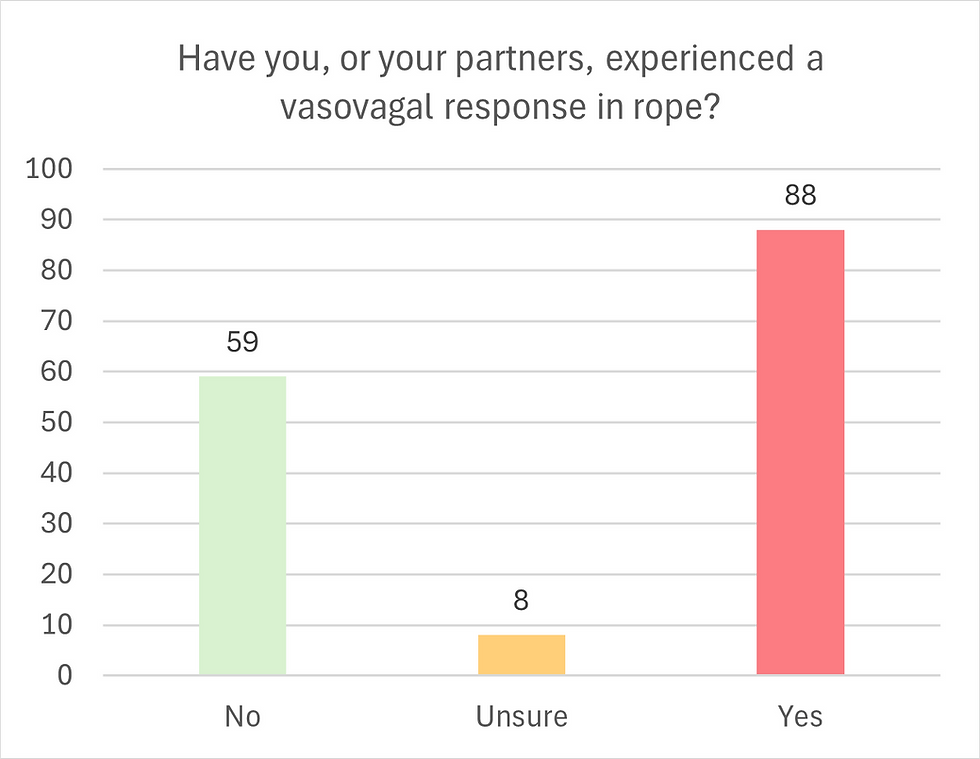
In our survey 88 out of 155 people (57%) said that they or a partner had experienced vasovagal syncope or presyncope in rope.
The Vagus Nerve
The Vagus nerve is a nerve that runs from the brain to several organs including the heart, lungs and gastrointestinal tract. The vagus nerve is one of the key nerves that connects the brain and the gut and helps to control many unconscious functions like digestion, heart rate and respiratory rate. The feeling of being full or hungry comes through the vagus nerve, the depth and frequency of breathing is also controlled through the vagus nerve.
Under stressful situations the body activates the autonomic nervous system, which allows us to respond more quickly if we are in danger. However, some people are more sensitive to misfiring of the autonomic nervous system, leading to a sudden drop in blood pressure and heart rate which leads to vasovagal syncope.

Why does this happen?
In an everyday setting there are a number of reasons that Vasovagal Syncope can happen, both somatic and psychosomatic.
Emotional
Some people can react to emotionally stressful situations with vasovagal syncope Situations can range from:
seeing blood
having an injection
hearing bad news
any other emotionally stressful or traumatic situations
During rope, many of us enjoy exploring difficult emotions and this may contribute to why many people experience vasovagal syncope in rope. However, there are also physical causes that might be easier to unpick.
Internal Somatic
If your body is under internal stress such as:
dehydration
hunger
being overheated
being in pain
standing up for a long time
standing up too quickly
Before a rope session, it is recommended that people who get tied regulate their hydration and hunger so that they are not near extremes during rope sessions. Likewise, if you are prone to overheating, you can change your clothing or the air conditioning temperature to set up the room to feel more comfortable.
Some ties also hold the person in rope in an upright shape for an extended period of time, which could be a cause of vasovagal syncope in rope. If the person being tied is more susceptible to vasovagal syncope, it could be sensible to plan your tie so that they are not in an upright position for so long - either by adding transitions to move out of the position, or by coming down from suspension earlier.
Medical Conditions
Certain medical conditions can also increase the risk of vasovagal syncope
Arrhythmia - uneven heart rate
Gastrointestinal illness
PoTS (Postural Orthostatic Tachycardia Syndrome)
As a side effect of some medications
If you have these medical conditions or you are not sure, it may be a good idea to consult your doctor about the risk before tying. If you already know your medical conditions make vasovagal syncope more likely, it can be important to inform the person you are tying with so that they can prepare better.
Physically Stimulating the Vagus Nerve with Pressure
In rope we can also physically stimulate the Vagus nerve by pressing on the area where the nerve interacts with the diaphragm in the center of the chest below the sternum. For this reason, in 15.9% of cases in our survey, vasovagal syncope and presyncope were attributed to tight rope around the waist or near the diaphragm.
However, since 64.8% of people that responded did not know what caused the reaction, this % could be underreported.

What Should I Do If It Happens?
The good news is that in most cases, vasovagal syncope and presyncope usually lasts less than one minute. General medical advice is to lay down or sit down and wait for the feeling to pass, and if possible, put the feet above the heart.
In rope, especially in suspension it is recommended to get the person tied out of suspension as quickly and safely as possible. Usually after a few minutes on the ground the person may feel ok to continue tying, but if vasovagal syncope is caused by a waist rope, you might want to consider removing it if you plan to tie more with the same harness. Likewise, if the vasovagal syncope was likely caused by being upright for too long, you probably want to consider tying something with different orientation.
We hope this information helps you to choose your harnesses and be more informed about some of the risks involved in doing rope.
Happy tying! - Rosa


Comments